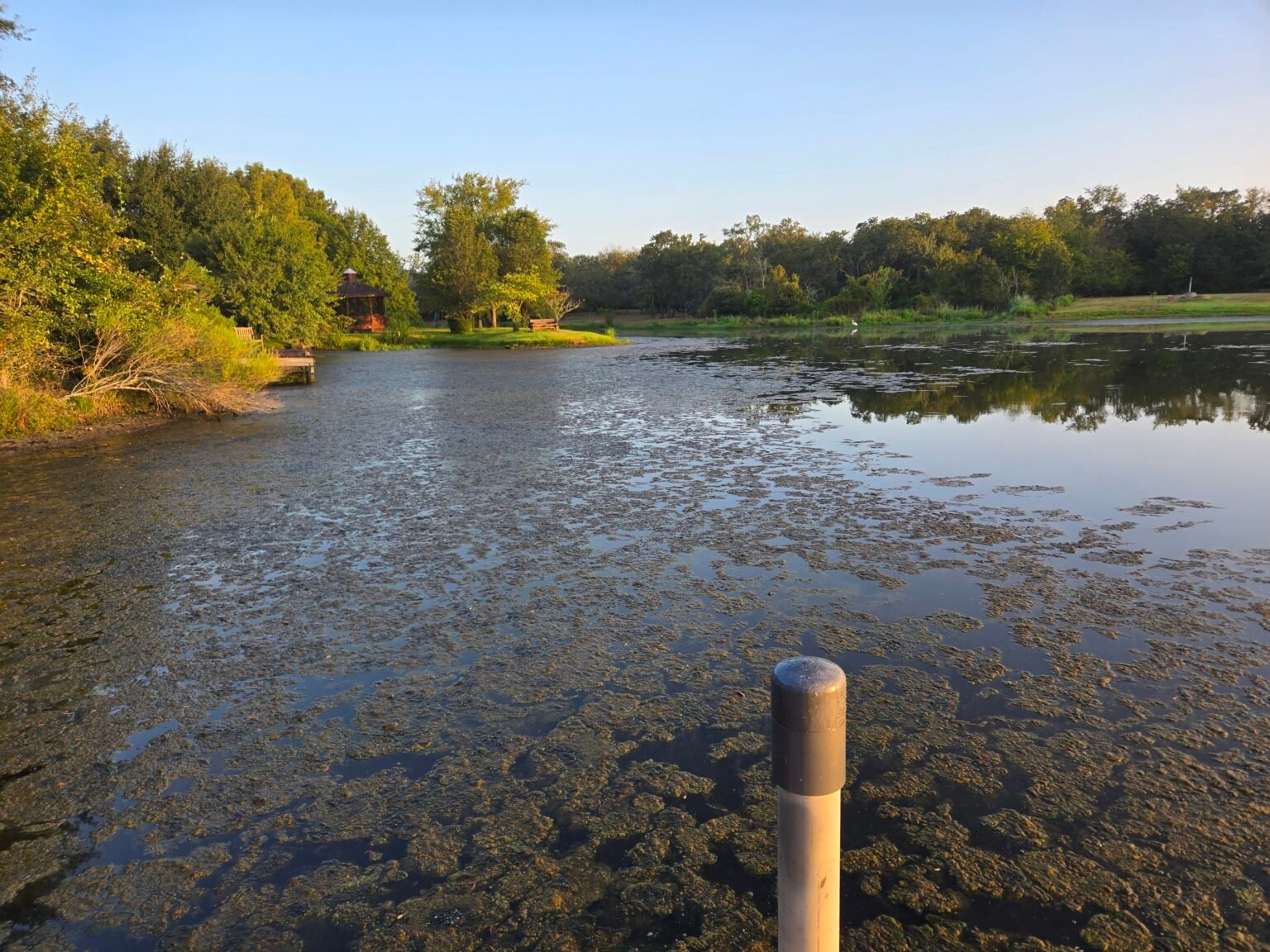
If you have spent time around our lake lately, you have probably noticed large green stringy mats floating on the water or collecting along the shoreline. This is commonly called filamentous algae, and it is a natural part of many lakes and ponds. When it grows excessively, as it has this summer, it becomes unsightly, interferes with boating and other recreational activities, collects around docks, and generally makes the shoreline less enjoyable. So the Board is working with experts to address the causes of this overgrowth and manage it in the future.
Filamentous algae are simple aquatic organisms that grow in long, thread-like strands. They are not usually toxic. Unlike other aquatic vegetation in our lake, filamentous algae do not have roots, stems, or leaves. Instead, they form tangled masses that can appear as green or yellow-green mats, sometimes resembling wet cotton or a thick layer of grass floating on the water. As large quantities of algae grow and die, they decompose and return nutrients to the water. This process, sometimes referred to as nutrient recycling, may contribute to continued algae growth.
Like other plants, the algae rely on sunlight and nutrients, including phosphorus, to grow. Testing has determined that our lake has elevated levels of phosphorous. Sources include stormwater runoff, fertilizers, decaying vegetation, and other organic material such as grass clippings. Failing or poorly functioning septic systems may also leak phosphorus into the lake. The most effective long-term way to combat filamentous algae involves identifying and reducing the sources of the excess phosphorus.
You may also have noticed that filamentous algae seems more abundant in shallow water. Since our lake is relatively shallow around many shorelines and private docks, sunlight can penetrate and support algae growth. This helps explain why some areas of the lake may have significant algae accumulation while other, deeper areas have considerably less or may not have visible algae at all.
The good news is that algae is seasonal. As water temperatures drop during autumn and winter, filamentous algae will typically go dormant, and visible mats will eventually disappear. Under normal conditions, the algae remains largely out of sight through the winter. This does not necessarily mean the underlying conditions supporting its growth have been eliminated. Mats may emerge again in late spring, when warmer temperatures and favorable growing conditions return.
In preparation for next spring and summer, we are working to devise a management plan in consultation with Dr. Brittany Chesser, Texas A&M AgriLife Extension Service. Dr. Chesser specializes in algae, aquatic plants, pond management, and water chemistry. As we evaluate potential solutions, we are considering practical approaches that take into account the size and characteristics of our lake, areas where algae growth is most severe, and ways to combat elevated phosphorus.
Homeowners who live around the lake may play an important role in protecting and improving water quality by taking simple steps to reduce the amount of nutrients entering the water. These include:
· Avoiding unnecessary fertilizer use near the lake
· Keeping grass clippings and leaves out of the water
· Properly maintaining septic systems and ensuring that discharge does not flow toward the lake
While it is impossible to prevent phosphorus from entering the lake or to eliminate all filamentous algae, our goal is to significantly reduce the conditions that contribute to its growth. By addressing sources of excess nutrients and taking practical steps to improve water quality, we hope to reduce algae growth and restore the beauty and overall appearance of our lake.